|
||
8. Kamacite spindles with schreibersite |
| Listing of Structures |
| Back...Next |
| Meteorite - Balambala,
IIF Iron. |
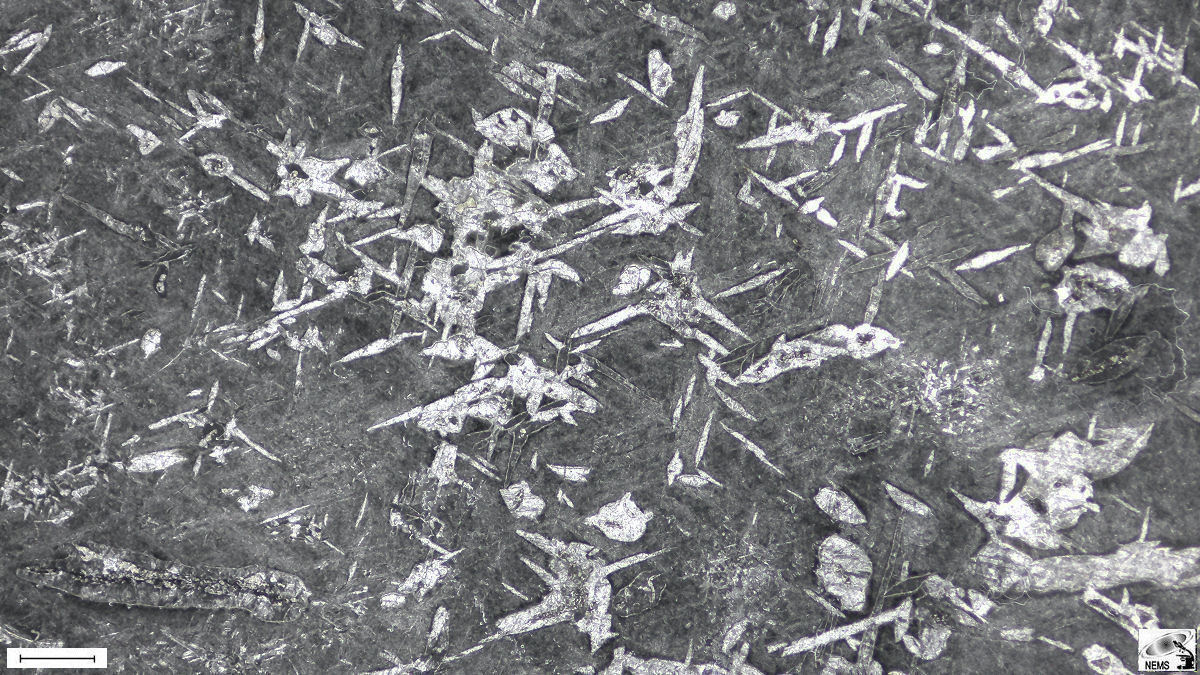 |
| Figure 1. Kamacite spindles with core inclusions of schreibersite in the Balambala (IIF) iron meteorite. Scale bar: 250 µm. |
| Kamacite spindles represent a distinctive microstructural feature in certain iron meteorites, formed through eutectic or near-eutectic crystallization processes within the Fe–Ni–P system. This mechanism, well-documented in both terrestrial metallurgy and meteoritics, occurs during the initial solidification and early cooling stages of the metallic melt, providing valuable constraints on a meteorite’s thermal history, cooling rates, and phosphorus content. In the Balambala meteorite, elongated kamacite (α-FeNi; low-Ni phase) spindles develop within a taenite (γ-FeNi; high-Ni phase) matrix. These spindles typically appear discontinuous or bayonet-like in polished sections and are arranged according to the octahedral symmetry of the parent taenite grains. Larger spindles frequently contain central cores of schreibersite ((FeNi)3P), a common phosphide mineral in iron meteorites that nucleates preferentially due to phosphorus partitioning during crystallization. Petrographic Context and Comparison Balambala, classified as a member of the rare IIF chemical group (one of only a small number of known specimens), is characterized by its high Ge/Ga ratio, elevated cobalt content, and nickel-rich composition. The kamacite spindles form a prominent part of its ataxitic to plessitic texture, reflecting relatively rapid cooling that favored the development of these fine, acicular structures rather than coarse Widmanstätten lamellae. Similar kamacite spindles occur in other iron meteorites, such as the Ballinoo, IIC specimen. However, a critical distinction lies in their post-formation histories. In Ballinoo, the spindles exhibit evidence of partial recrystallization attributable to terrestrial (artificial) heating, which has modified their internal structure and boundaries. In contrast, Balambala preserves primary features without such overprinting, offering a clearer window into asteroidal processing. These structures underscore the role of minor elements (particularly P) in modulating phase equilibria and microstructure in iron meteorites. Schreibersite cores within kamacite spindles highlight subsolidus growth and element partitioning, with implications for cooling rates estimated on the order of those typical for IIF irons. Further microanalytical studies (e.g., electron probe microanalysis) could refine nucleation temperatures and diffusion kinetics. |
| Reference
Buchwald, V. F. (1975). Handbook of Iron Meteorites. University of California Press. Meteoritical Bulletin Database; Kracher et al. (1980) on IIF group definition. Additional/Supporting References Meteoritical Bulletin No. 109 (2021): Detailed petrographic description of Balambala by C. Herd, L. Tunney, et al. (University of Alberta). It explicitly notes: “The bulk of the meteorite consists of kamacite spindles in a matrix of taenite… larger kamacite spindles or groupings of spindles are often cored by 50-100 µm subequant schreibersite crystals.” Average kamacite bandwidth ~53 µm. This is the primary modern reference for Balambala’s microstructure. Rasmussen et al. (2001) — “Metallographic cooling rates of group IIF iron meteorites” (Meteoritics & Planetary Science). Discusses IIF irons (including structures with kamacite spindles), Ni profiles through taenite rims enclosing spindles, schreibersite influences on bandwidth measurements, and cooling rates (~5°C/Ma based on taenite, with undercooling considerations). It addresses why prior kamacite bandwidth estimates may be off due to large schreibersites. |
| Listing of Structures |
| ... |